

Takeichiro Hirai: A Life in Music
“I have taken him with me throughout all of Europe, and
I have taught him all that I know. He will be my successor!”
— Pablo Casals
Internationally acclaimed as one of the greatest cellists of our time, Takeichiro Hirai is one of the last surviving musicians who inherited the legacy of great masters from the late 19th and early 20th centuries.
His circle of musical friends resembles a microcosm of the Golden Age of Classical Music, having associated or collaborated with legendary figures including composers such as Kreisler, Villa-Lobos, Nadia Boulanger, Georges Auric, Britten, Shostakovich, and Khachaturian; violinists like Elman, Szigeti, Menuhin, Stern, and Kogan; cellists such as Piatigorsky, Fournier, Tortelier, Rose, Rostropovich, and Jacqueline du Pre; pianists including Cortot, Horszowski, Kempff, Sanroma, Serkin, Istomin, and Katchen; guitarist Andres Segovia; and conductors like Stokowski and Szell.
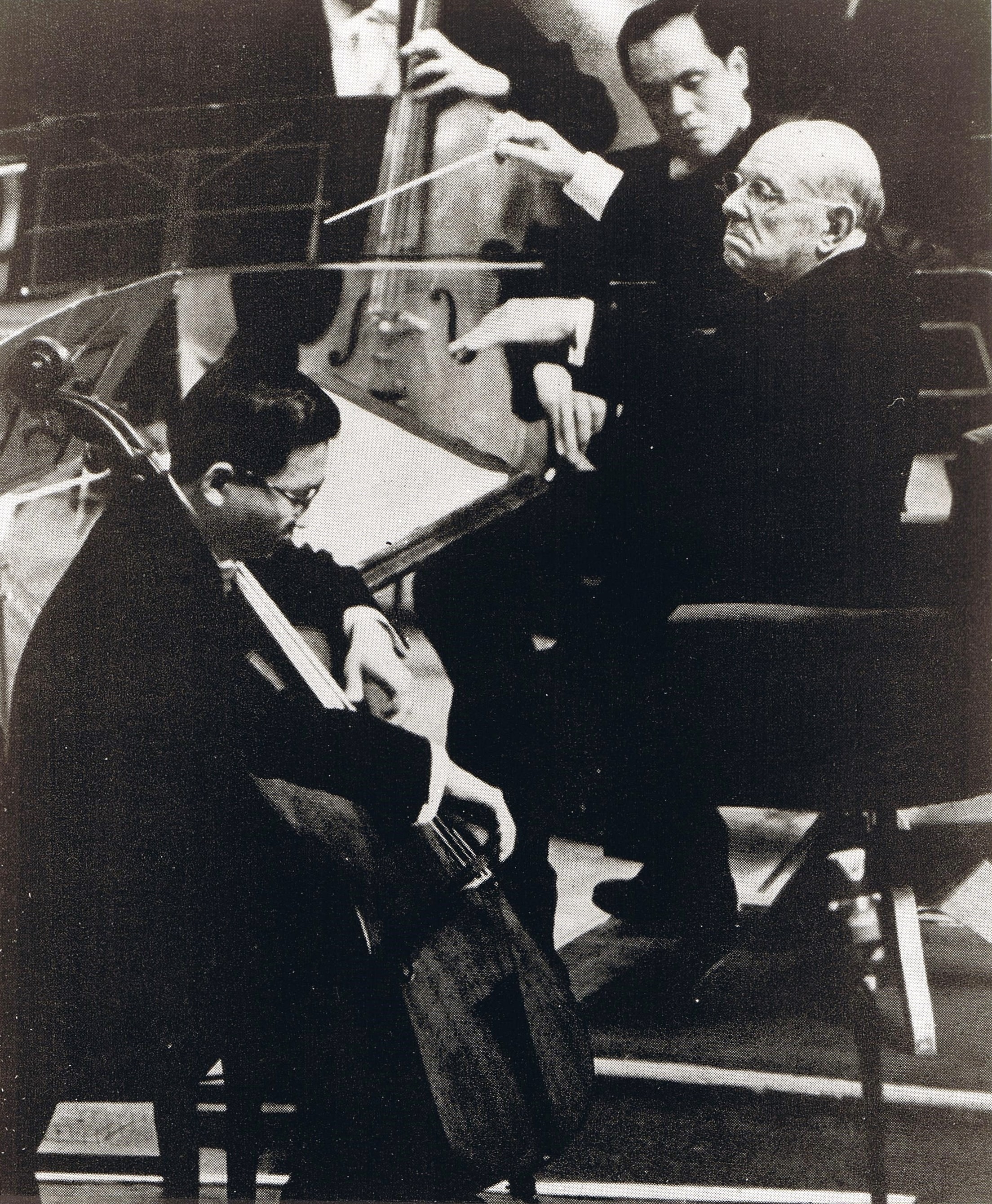
Since his sensational debut in 1961 playing four major cello concerti conducted by Pablo Casals (1876-1973) – the undisputed “King of the Cello” and 20th-century master who revolutionized modern technique and rediscovered Bach’s solo suites – Hirai has been performing regularly across the globe.
He appears as a soloist with the world’s leading orchestras and as a recitalist in prestigious venues such as the Musikverein (Vienna), Concertgebouw (Amsterdam), Wigmore Hall (London), Salle Gaveau (Paris), Great Hall (Moscow), NHK Hall (Tokyo), Kennedy Center (Washington D.C.), and Carnegie Hall (NY).
Hirai has been honoured with many prestigious awards, including the Prix Extraordinaire at the 1st Pablo Casals International Competition in Paris (1957) and the Composer’s Union Special Prize at the 2nd Tchaikovsky International Competition (1962).
Hirai’s performances during the latter were met with overwhelming support from the audience. It is widely said that jury members Dmitri Shostakovich, Aram Khachaturian, and Dmitry Kabalevsky hastily established the “Soviet Composers Union Special Prize” specifically for Hirai as a silent protest against a biased judging process, with Shostakovich himself personally presenting the award.
Born in Tokyo in 1937, Hirai is the eldest son of the renowned composer Kozaburo Y. Hirai and violinist Yumiko Hirai. A prodigious talent, he composed nearly 100 works, including a piano concerto, by the time he was in elementary school, frequently touring and appearing on national broadcasts as a pianist.
He began his cello studies at age 12 under Hideo Saito at the Toho Gakuen School of Music. In only four years, he won first prize at the prestigious Japan Music Competition (1954).
The year 1956 saw a turning point when Gregor Piatigorsky – one of the 20th century’s foremost cellists, famously known for his piano trio with Jascha Heifetz and Arthur Rubinstein – marvelled at Hirai’s performance.
Piatigorsky immediately wrote a letter of recommendation to his own idol, Pablo Casals, passionately urging him to take the young cellist under his wing.
In 1957, Hirai relocated to study under the maestro Pablo Casals, where he devoted himself not merely to the ultimate mastery of the cello, but to absorbing the profound essence of music itself.
During his studies from 1957 to 1961, Hirai frequently travelled with Casals and his wife Marta. He accompanied them not only in Puerto Rico but crossed the Atlantic back and forth every year by ship and airplane, touring across Europe and participating in festivals such as Prades.
This legendary festival had originated in a small village in the French Pyrenees, where Casals lived in self-imposed exile as a protest against the dictatorship. Because Casals refused to perform elsewhere, the world’s most renowned musicians gathered in this remote location to perform with him, creating an event of profound historic importance.
Throughout his life, Casals was a tireless advocate for world peace, a mission inseparable from his role as a visionary conductor and composer whose music sought to touch the universal human spirit. A nominee for the Nobel Peace Prize and recipient of the UN Peace Medal (1971), he famously performed his arrangement of the Catalan folk song ‘Song of the Birds’ as a prayer for peace. In his historic speech at the United Nations, he moved the world by declaring that even the birds in the sky sing ‘Peace, Peace, Peace’ – or ‘Pau, Pau, Pau’ in his native Catalan, where ‘Pau’ is both the word for ‘Peace’ and the Catalan form of his own name.
Embodying the 19th-century ideal of the “complete musician,” Hirai earned Casals’ absolute trust through his ability to sight-read complex orchestral scores on the piano. Furthermore, during one of these European tours, when the sheet music for a piece composed by Casals himself went missing just before the concert, Hirai swiftly orchestrated the accompaniment from memory.
Following these formative years, his triumphant return debut in 1961 featured performances of four major cello concerti (Dvorak, Schumann, Lalo, and Boccherini) in Tokyo and Kyoto, conducted by Maestro Casals himself, then 84.
The Tokyo concert was graced by the presence of then-Crown Prince Akihito and Crown Princess Michiko (the former Emperor and Empress of Japan), as well as former Prime Minister Shigeru Yoshida.
This legendary live broadcast, long considered a ‘phantom performance’, was later released on CD by EMI and Universal Music (TBS Vintage Classics) – complete with the actual voices of Casals and Hirai from their press conference – capturing the fervour of the historic event.
At a press conference in New York that same year, Maestro Casals noted: “I have taken him with me throughout all of Europe, and I have taught him all that I know. He will be my successor!”
Since then, Hirai has toured no less than 40 countries across 4 continents, giving highly successful concerts as well as performing in various international music festivals including Prades (France), Casals (Mexico), Estherwood (Spain), Marlboro (USA), and Zermatt (Switzerland).
Their bond remained profound; in 1972, the year before his passing, Casals called for Hirai to spend three months with him to impart his final, lifelong musical revelations regarding Bach’s Solo Suites.
During this time, Casals also provided extensive advice on Hirai’s soon-to-be-published edition of Beethoven’s complete cello works, even contributing a foreword of recommendation.
Hirai’s global career brought him into contact with many other luminaries. His artistry profoundly moved Heitor Villa-Lobos in Mexico in 1958, leading the composer to promise a dedicated work for Hirai – a promise tragically left unfulfilled by Villa-Lobos’s passing the following year.
At times, Hirai enjoyed dining and engaging in deep conversations with iconic musicians like Segovia alongside Casals, and at other times, he shared these culturally rich moments with legendary figures such as Marlene Dietrich.
A champion of both standard and neglected repertoire, Hirai regularly performed complete cycles of cello works by Bach, Beethoven, and Brahms.
He also made immense contributions to expanding the chamber music repertoire for cello and piano by transcribing numerous sonatas originally written for other instruments by Baroque composers, as well as Mozart, Schubert, and Brahms.
Furthermore, he championed the works of his father, Kozaburo Hirai, frequently premiering numerous pieces dedicated to him – such as the ‘Cello Sonata’ and ‘Paraphrase on “Sakura Sakura”‘ – and introducing them to audiences worldwide.
In addition, Takeichiro gave the premieres of works by numerous other composers, including the historic 1966 Japanese premiere of Haydn’s Cello Concerto No. 1 (with his own cadenza) – a work that is now standard repertoire but had only recently been discovered at the time – which was broadcast nationwide on TV and radio.
Ambitiously undertaking both playing and conducting, he performed three cello concerti (Haydn, Saint-Saens, and Dvorak) with the Tokyo Philharmonic Orchestra in a single concert in 1979. The live recording of the Dvorak, highly regarded by experts as the ‘definitive performance’ of the work, was later released on LP and CD to immense critical acclaim.
In 1976, he was appointed as an International Advisor to the UN Symphony Association in New York, alongside Leonard Bernstein, Claudio Arrau, and Ravi Shankar.
Starting in 1980, his role as an Artistic Emissary of the Japanese government led Hirai to several European countries.
Furthermore, accompanied by his wife Minako Hirai at the piano, he toured the US, 7 Latin American and 5 Asian countries, where they received the warm welcome of royal families and leaders of the respective countries, including President Corazon Aquino of the Philippines.
In 1988, he was invited by Nancy Reagan to give an opening concert as a special guest artist at the First World Cello Congress held in Washington, D.C., where he was also a member of the specially formed cello octet with other noted cellists such as Tortelier, Rostropovich, and Greenhouse.
In 1993, commissioned by Nippon Television, he composed, conducted, and premiered his own “Celebration Overture” for cello and orchestra for the royal wedding of Crown Prince Naruhito and Crown Princess Masako (the current Emperor and Empress of Japan), which was broadcast nationwide.
As a prolific composer, Hirai has left notable achievements across a wide range of genres, including orchestral works, choral pieces, chamber music, lieder, and piano compositions.
His extensive output includes orchestral pieces, sonatas, and numerous works for cello and piano, such as ‘Poem of Isla Verde – Memories of Maestro Casals’ (for cello and string orchestra), ‘Fantasy on “Lorelei”‘ (for cello and orchestra or piano), ‘Classical Sonata’ for cello and piano, ‘Melody in A’, and ‘Ode’ for cello ensemble.
Among these, his masterful works for unaccompanied cello truly push the instrument’s possibilities to their absolute limits in both technique and expression: his Suite “Latina” (1981), which incorporates virtuosic techniques inspired by his old friend Segovia; and his Fantasy “Hokusai” (1993).
Just like Hokusai’s own art, which possesses a vast, universe-like quality that transcends all boundaries, the latter piece transcends not only classical limits but also time and space, bridging the East and the West, and even gaining widespread acclaim on British Jazz FM and the New York jazz scene.
Hirai has always been a dedicated promoter of world peace, participating in a series of World Hunger Benefit Concerts with organisations such as the United Nations, and delivering a profoundly moving recital at Auschwitz in 1995. He has also frequently held charity concerts to support recovery efforts following earthquakes and other natural disasters.
He has taught at the Juilliard Summer School, served on juries for international competitions, was a professor at the Toho Conservatory of Music (1972-1990), and served as the chairman of the Association of Composers and Authors in Japan (2003-2018).
He has broadcast internationally on radio and television and has made over 30 critically acclaimed recordings with labels such as Sony, RCA, EMI, and Universal Music.
In 2021, he founded the annual Kozaburo Hirai Vocal Competition to foster emerging musical talent, and has served as the Chairman of the Jury ever since.
In 2005, Takeichiro Hirai celebrated his Golden Jubilee as a cellist, giving a special gala concert at the prestigious Tokyo Kioi Hall (a performance now available on live CD). He performed Bach’s Solo Suite No. 1 and two concerti by Dvorak and Schumann. For this monumental occasion, he was joined by his two highly renowned sons, conductor Hideaki Hirai and pianist Motoki Hirai, for the world premiere of his own ‘Poem “Catalan” for cello, piano and orchestra in memory of Pablo Casals’, bringing the programme to a moving close with ‘Song of the Birds’.
In 2009, Hirai returned to Europe for a tour commemorating the 30th anniversary of the historic return of Casals’ remains to his homeland. Following the end of the dictatorship, the remains of the maestro had finally been brought home to El Vendrell in 1979.
Joined from London by his son, Motoki, he appeared in recitals and music festivals across England, Denmark, Spain, Romania, and France. Their performances included concerts at prestigious venues such as Wigmore Hall and the Auditori Pau Casals in El Vendrell, a suburb of Barcelona and Casals’ hometown.
Concurrently, a special exhibition titled “Pau Casals and Takeichiro Hirai” was held at the adjacent Museu Pau Casals. This garnered significant attention by showcasing rare photographs and personal correspondence, with Marta Casals-Istomin traveling all the way from the US to personally offer her congratulations.
In his later years, Hirai continued to captivate audiences. For his ’80th Birthday Concert’ (2017) (now available on live CD/DVD) and ’65th Debut Anniversary Recital’ (2019), he performed demanding three-hour programs entirely from memory, as has been his practice throughout his long career, proving his status as a living legend.
An artist of unyielding spirit, Hirai has overcome immense physical challenges, surviving five strokes since 2015 and enduring a bedridden state during the COVID-19 pandemic.
Living with the constant threat of a ruptured abdominal aortic aneurysm – surgery for which had to be delayed for two years due to his weakened condition following the strokes – he successfully underwent the critical operation in the autumn of 2025.
Publicly revealing his health battles for the first time in 2026, he has returned to rigorous rehabilitation and practice.
Now looking toward the future, the music world eagerly anticipates his performances in the autumn of 2026 to commemorate the 150th anniversary of Casals’ birth, alongside the publication of his long-awaited autobiography.

